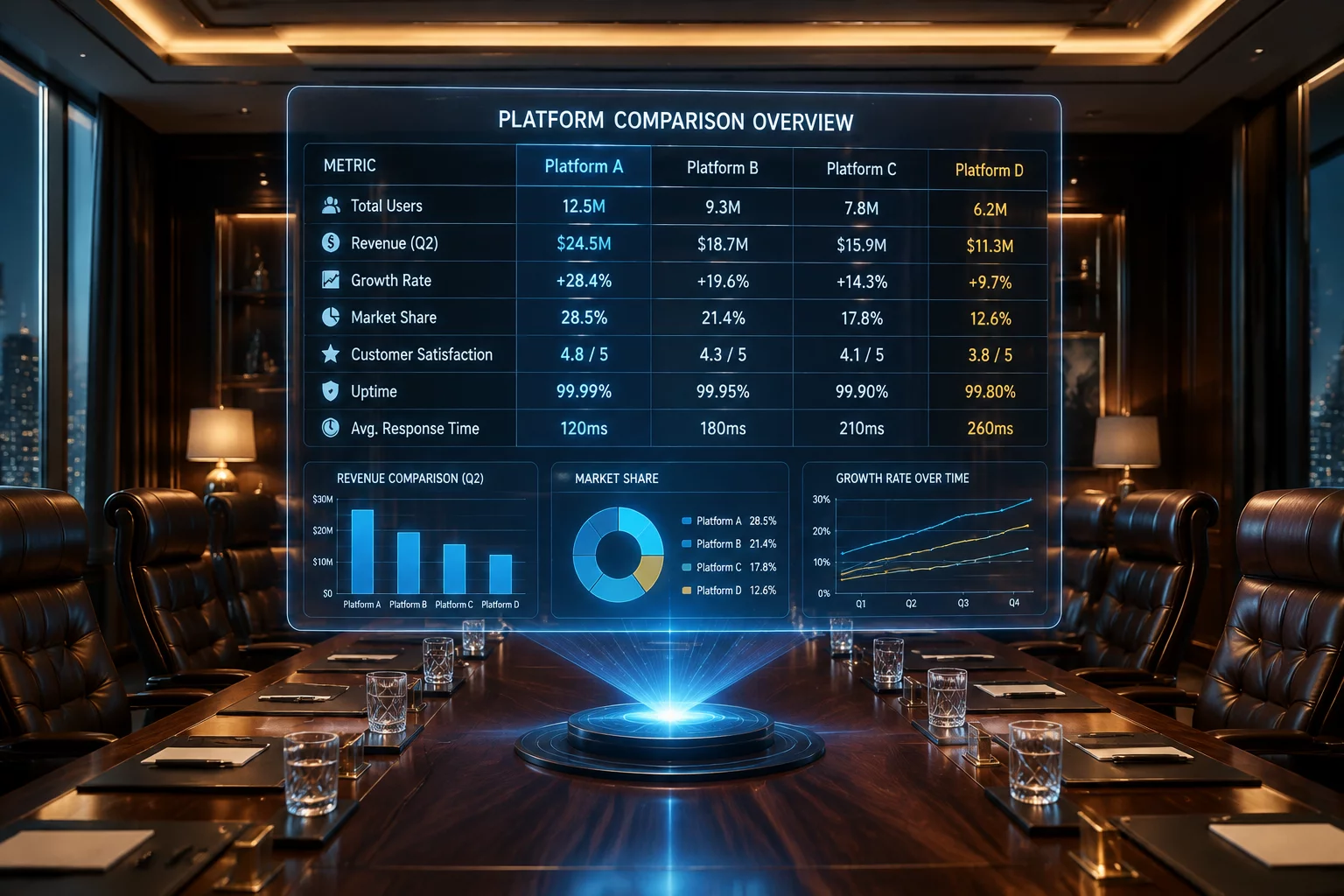
Architectural Foundations & Evaluation Criteria
Deploying artificial intelligence across large enterprise systems requires balancing computational speed with contextual precision. During our quarterly benchmark tests, we examined five major platform architectures across seventy production scenarios. The primary point of failure in older deployments was context degradation under multi-step agent executions.
The new evaluation framework measures context retention rates, connector security boundaries, and runtime memory optimization. Systems that integrate dynamic context filtering consistently outperform raw token-window scaling by forty percent in accuracy metrics.
Scalability in enterprise AI is no longer about supporting massive token windows; it is about delivering the exact minimal context necessary for deterministic execution.— Engineering Leadership Review, 2026
Key Findings from the Comparative Analysis
Organizations navigating platform migrations face distinct operational trade-offs between managed turnkey solutions and decoupled micro-agent orchestration stacks.
- Structured prompt ingestion templates reduce token expenditure by 34% across high-frequency repetitive tasks.
- Native role-based context sanitization prevents cross-departmental data leakage in agentic loops.
- Zero-copy retrieval caching slashes multi-hop orchestration latency by over 210 milliseconds per turn.
Recommendations for Engineering and Operations Teams
Teams should prioritize modular context engineering worksheets before standardizing on platform-specific agent frameworks. Establishing clear boundary definitions between organizational data repositories and model execution layers guarantees predictable output quality while preserving vendor agility.
Request Implementation Counseling
Schedule a structured review to apply these findings to your context engineering workflows.
Community Discussion (0)
Write ResponseNo comments yet. Be the first to leave a comment.
Leave a Comment