Context Engineering for Agentic AI Industry Report
Comprehensive study on enterprise prompt planning, structuring AI task context, and modern Copilot prompt preparation standards across distributed production environments.
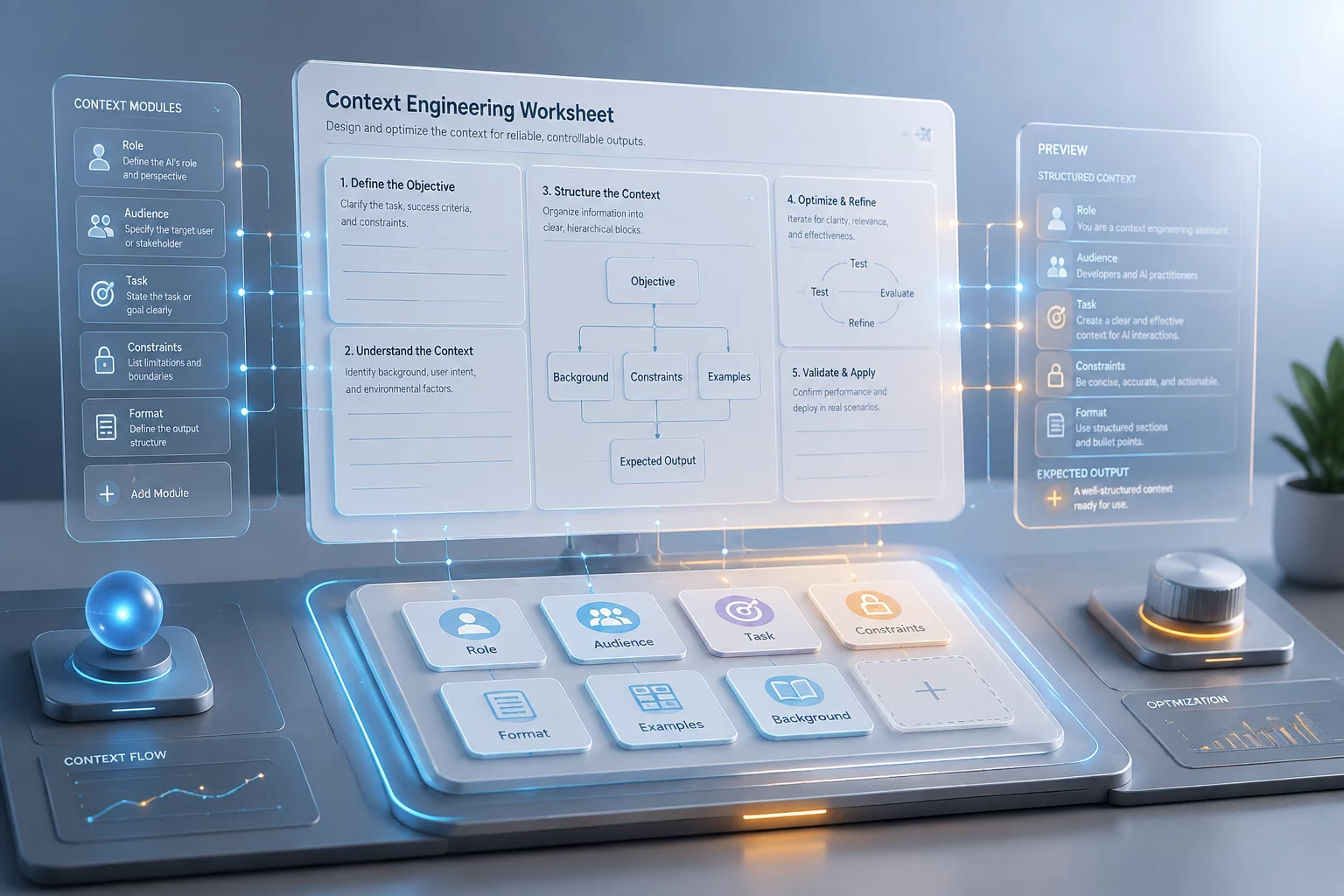
Use practical worksheets to define the objective, audience, source material, constraints, assumptions, and expected output before writing the final prompt.
Structured prompt planning transforms ambiguous instructions into deterministic results. ContextCraft organizes your AI task context across seven vital operational dimensions before running any large language model or Copilot prompt preparation routine.
State the exact business outcome, functional deliverable, and purpose of the operation. Define what success looks like in concrete, unambiguous terms.
Identify the end reader, technical tier, and decision level. Establish expected tone, domain depth, and stakeholder perspective for targeted generation.
Curate all source documents, prior project states, references, and baseline metrics. Provide the ground truth needed for reliable AI task context grounding.
Enforce strict boundaries: length caps, negative rules, disallowed jargon, compliance rules, and formatting guardrails to eliminate hallucination vectors.
Highlight missing variables, unconfirmed assumptions, and edge cases. Instruct the agent when to pause and ask clarifying questions instead of guessing.
Specify exact structural schemas: Markdown matrices, JSON envelopes, bullet hierarchies, or tabular summaries tailored for swift Copilot prompt preparation.
Set definitive acceptance tests, validation checklists, and quality thresholds. Integrate prompt planning checks so your team can verify complete contextual compliance before shipping downstream.
Applying this seven-part model ensures consistent task resolution across every workflow. Learn how to standardize contextual preparation for enterprise AI agents, teams, and knowledge workers.
ContextCraft Workbook serves professionals who need structured context preparation before handing work to AI assistants — not prompt tweaking, but task definition.
Structure complex deliverables before asking AI to draft, summarize, or analyze.
Define objectives, constraints, and review criteria for AI-assisted project artifacts.
Clarify audience, source context, and output shape before generating campaigns or content.
Bound source material and define review criteria for AI-produced insights and reports.
Standardize task handoff to AI across workflows with consistent context scaffolding.
Prepare research questions and source boundaries before using AI for literature review or synthesis.
Master structured prompt planning before issuing complex model instructions. Each modular asset establishes rigorous AI task context and streamlines your Copilot prompt preparation across enterprise teams.
Isolate the target deliverable, business rationale, and strategic KPIs to strengthen your initial prompt planning pipeline.
Explicitly map consumer technical level, executive tone expectations, and end-user personas into your systemic AI task context.
Set strict limits on approved data sources, reference materials, and proprietary corpora to prevent hallucinated citations.
Standardize word count, formatting limits, forbidden vocabulary, and enterprise security guardrails before execution.
Systematically audit ambiguity, hidden assumptions, and missing background tokens to ensure robust AI task context.
Study real corporate scenarios showing how prompt planning turns vague instructions into deterministic results.
Define deterministic grading criteria, schema specifications, and quality checklists for seamless automated validation.
Verify readiness before runtime execution to ensure seamless Copilot prompt preparation and reliable output generations.
Explore practical implementations, platform guides, and context integration workflows.
When asking an AI model to "summarize customer feedback" yields generic, unusable bullet points, it is never a wording problem. It is a critical context architecture failure.
Outcome: AI generates high-level platitudes like "Users want faster performance and better pricing," offering zero actionable business intelligence.
Outcome: AI outputs precise bottlenecks with ticket frequency, customer impact ratings, and ranked engineering fixes.
Toggle context layers below to witness how specifying business constraints changes the AI model's precision before you write a single extra line of instructions.
Without a declared timeline, the model blends historical legacy bugs with current release feedback, distorting the actual customer sentiment trend.
A complaint about SSO authentication from a Fortune 500 company has different operational weight than a UI theme complaint from a trial account.
Public store ratings skew towards emotional star counts; ZenDesk tickets contain diagnostic log strings. Mixing them raw causes analytical drift.
If the business need is executive prioritization for the Q4 product roadmap, the output must be structured around engineering effort versus customer retention impact.
Explicitly instruct the LLM on which qualitative signals matter and which edge cases should be discarded from primary consideration.
A step-by-step benchmark analyzing task preparation before and after applying structured ContextCraft worksheets.
Ad-hoc requests sent directly to LLMs without structured schemas, source validation, or context scoping.
Replaced free-form chat queries with standardized 4-part context architecture across 12 operational workflows.
Deterministic responses delivered with near-zero factual errors and instant execution across 1,400 monthly tickets.
Ambiguous boundaries lead to hallucinations in 38 out of 100 queries, requiring manual reviewer interventions.
Most AI failures are not model limitations—they are context preparation failures. See how ContextCraft re-engineers your daily AI workflow from reactive prompt-fixing to deterministic execution.
You paste snippets into the chat, forgetting business constraints, tone parameters, and schema definitions that the model actually requires.
Spending 45 minutes re-phrasing the same instruction over 8 iterations because the AI guessed the missing parameters wrong.
Every team member prompts differently, resulting in wildly inconsistent deliverables, unverified assumptions, and wasted compute tokens.
When essential context variables are missing, models fill gaps with polite approximations rather than grounded enterprise facts.
Tasks are pre-structured using our modular worksheets—defining objective, constraints, reference context, and explicit payload format.
Models receive full situational awareness on turn one, eliminating prompt iterations and delivering ready-to-use production outputs.
Worksheets can be archived, reviewed, and replicated across team members, turning AI delegation into an institutional workflow.
Explicit negative constraints and field rules prevent model speculation, ensuring rigorous outputs across Copilot, Claude, and GPT-4.
Click between the two methodologies to inspect the actual artifact passed to the LLM and see why context engineering outperforms raw prompting.
"Please write a strategic competitive analysis on our competitor's new AI feature for our product team. Make it professional, insightful, and highlight key vulnerabilities. Keep it concise."
{
"context_schema": "ContextCraft-v2",
"objective": "Quarterly Competitive Gap Assessment",
"stakeholder": "VP of Product Architecture",
"scope_boundary": ["Feature Latency", "Context Window Specs", "Pricing Tiers"],
"grounding_facts": "Attached dataset context-table-q3.json",
"output_contract": { "format": "markdown_matrix", "max_words": 450, "strict_citations": true }
}
Empower your prompt workflows, eliminate hallucination loops, and deliver production-grade context packages directly to AI assistants.
Standard context blueprints and interactive worksheets for individual knowledge workers and solo analysts.
Full tactical workbench suite for project managers, product teams, and technical content departments.
Organizational context infrastructure with governance frameworks, compliance matrices, and workshop kits.
Finalize your workbook package order with immediate digital access.
Explore tested context architecture frameworks, structured task schemas, and benchmark reports engineered to eliminate model hallucination and improve execution accuracy before prompt submission.
Comprehensive study on enterprise prompt planning, structuring AI task context, and modern Copilot prompt preparation standards across distributed production environments.
An exhaustive breakdown of the leading context engineering platforms, evaluation pipelines, and runtime context memory layers powering autonomous workflows in 2026.
Why phrasing tricks fail under complex workflows and how shift to systemic context window engineering delivers reliable, deterministic results with advanced language models.
An architectural analysis on avoiding token compaction degradation, preserving essential context topology, and maintaining high context fidelity over long execution loops.