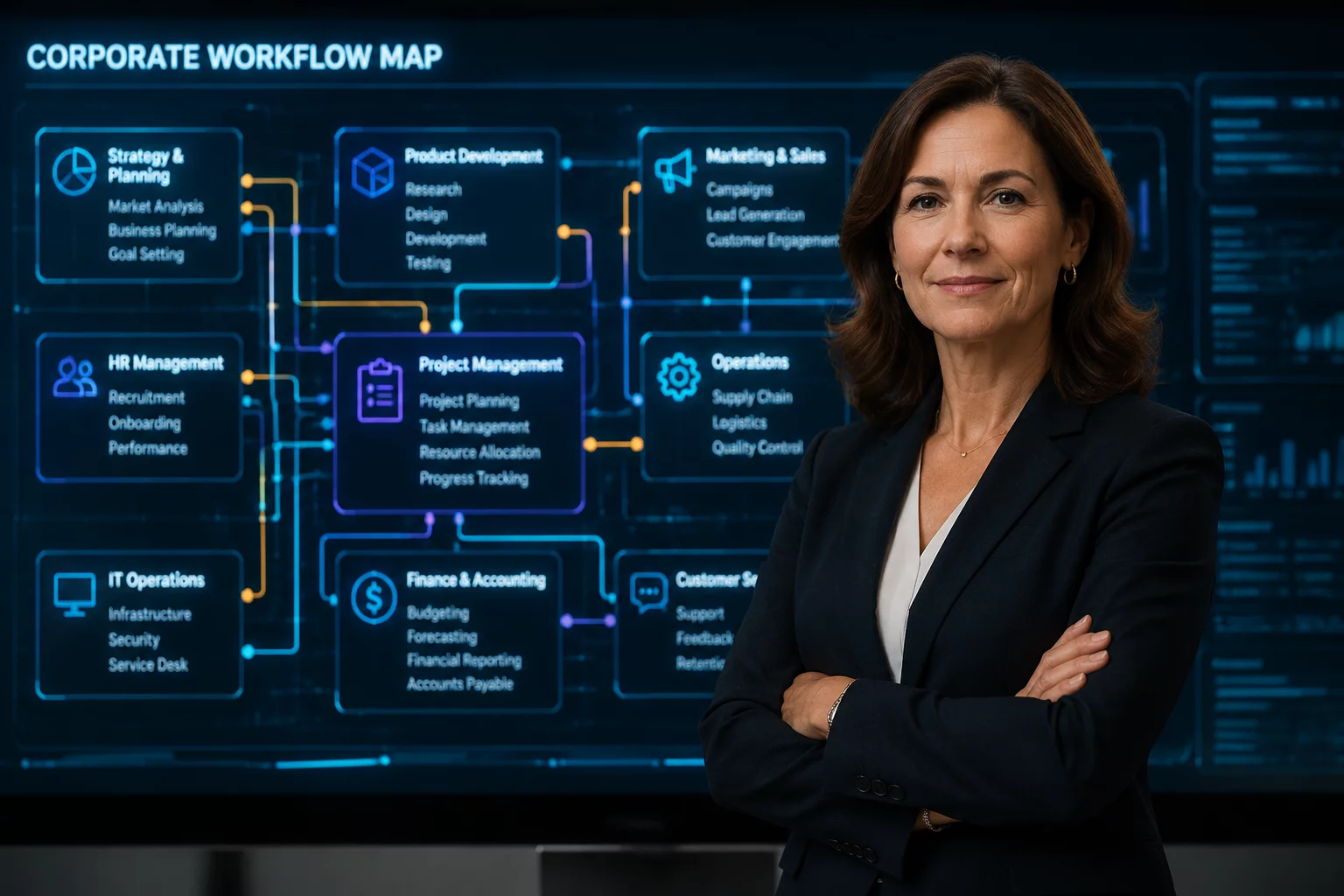
The Strategic Pivot from Standalone LLMs to Native Ecosystems
Information leaders across global corporations are redefining how they benchmark artificial intelligence investments. The initial wave of corporate experimentation rewarded raw model capability, prompting teams to adopt isolated chat interfaces and ad-hoc assistant tools. Today, chief information officers recognize that isolated productivity spikes do not translate into measurable operational throughput. The true benchmark has transitioned toward deep workflow integration, where autonomous agents and language models operate natively inside ERP, CRM, and internal collaboration backbones.
Operational data silos create severe context fragmentation, rendering even the most advanced foundation models unreliable without structured background injection. When software systems operate in silos, workers spend considerable time copying data between disparate tools rather than executing high-value business tasks. Enterprise IT strategies now mandate unified data layers and strict protocol adherence, ensuring that any agentic tool receives real-time context directly at the execution node.
Core Integration Principle
Better context before more prompting remains the guiding architectural axiom for modern enterprise technology stacks. Autonomous workflows succeed only when domain grounding precedes model invocation.
Key Architecture Pillars Demanded by Enterprise Leadership
Engineering roadmaps reviewed by enterprise procurement committees consistently emphasize four fundamental pillars required for scalable agentic deployment:
- Bidirectional Context Synchronization: Dynamic state sharing across enterprise repositories and runtime memory stores without manual re-prompting.
- Granular Role-Based Data Isolation: Contextual filtering engines ensuring sensitive business parameters never cross tenant boundaries or unauthorized clearance tiers.
- Protocol-Standardized Tool Execution: Universal schema utilization such as Model Context Protocol to drive seamless software instrumentation.
- Auditability and Deterministic Fallbacks: Real-time telemetry monitoring agent execution pathways with automatic human-in-the-loop intervention triggers.
Organizations deploying these principles observe dramatic reductions in hallucination rates and workflow churn. By engineering context before queries execute, enterprise teams avoid iterative trial-and-error cycles. Software systems extract required context parameters automatically, validate permission boundaries, and deliver actionable results directly into production systems.
“The competitive advantage no longer belongs to companies with the largest model subscriptions, but to architectures that seamlessly ground AI execution inside live corporate telemetry.”
As enterprise architectures mature throughout 2026, CIOs continue to retire fragmented point solutions in favor of unified context orchestration layers. Technology leaders seeking sustained efficiency gains must evaluate software partners based on their capacity to integrate directly into active data streams rather than their marketing promises of standalone intelligence.
Discussion (0)
No comments yet. Be the first to share your perspective!
Join the Discussion